


10 Best Hot Air Rework Stations for Mobile Repair in 2026
A good hot air rework station is one of the most important tools for anyone doing mobile phone motherboard repair, IC replacement, SMD rework, connector replacement, and chip-level servicing.
Choosing the right station can be confusing because there are hundreds of models available, ranging from inexpensive beginner machines to professional rework stations costing considerably more.
For mobile repair, however, the most expensive machine is not always the best choice. Stable airflow, accurate temperature control, heat recovery, nozzle selection, reliability, and availability of replacement parts are more important than simply looking at the wattage printed on the box.
In this guide, we have selected and ranked 10 hot air rework stations suitable for mobile phone repair in 2026, covering options for beginners, repair shops, and experienced motherboard technicians.
Note: Product specifications and prices can vary by model revision, seller, and market. Always verify the exact specification before purchasing.
What Is a Hot Air Rework Station?
A hot air rework station uses controlled heated air to heat components and solder on a PCB.
Unlike a normal soldering iron, hot air can heat an area around a component, making it useful for removing and installing components with multiple solder connections.
In mobile phone repair, a hot air station can be used for:
- IC removal and replacement
- Charging IC repair
- Power-management IC work
- SMD component removal
- Connector replacement
- Shield removal
- BGA-related rework
- Solder pad preparation
- PCB rework
- Small component soldering and desoldering
For motherboard work, controlled heat is extremely important. Excessive temperature or uncontrolled airflow can move nearby components, damage pads, or cause unnecessary PCB damage.
How We Selected These Hot Air Stations
For this ranking, we considered factors that are particularly important for mobile motherboard repair:
- Temperature control
- Airflow stability
- Heating performance
- Temperature recovery
- Handle ergonomics
- Nozzle availability
- Reliability
- Suitability for continuous repair work
- Value for money
- Availability and reputation among repair technicians
Community discussions also repeatedly recommend the Quick 861DW and ATTEN ST-862D for serious electronics and board-repair work, while the Sugon 8630 Pro is frequently considered a strong value option.
Top 10 Hot Air Rework Stations for Mobile Repair
1. Quick 861DW – Best Overall
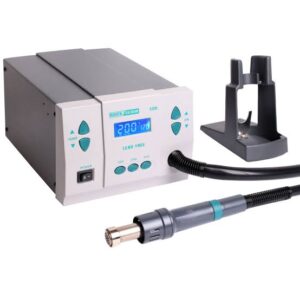
The Quick 861DW is one of the most well-known hot air rework stations among electronics and motherboard repair technicians.
It is particularly attractive for technicians who perform repairs every day and want a station that can handle repeated IC and PCB work.
Why we rank it #1
The biggest strengths of the 861DW are its stable airflow, temperature control, fast heat recovery, and proven track record.
It is suitable for:
- Mobile motherboard repair
- IC replacement
- SMD rework
- Connector replacement
- PCB repair
- BGA-related work
- Professional repair shops
The Quick 861DW is frequently recommended by experienced electronics repair users, and current repair-focused comparisons continue to list it as a professional choice.
Pros
- Excellent airflow control
- Good temperature stability
- Suitable for frequent professional use
- Large selection of compatible nozzles
- Proven reputation
- Good choice for chip-level repair
Cons
- More expensive than basic stations
- Genuine units can be more expensive than clones
- Beginners may not need to spend this much initially
Best for
Professional mobile repair technicians and high-volume repair shops.
Our rating: 5/5
2. ATTEN ST-862D – Best Professional Value
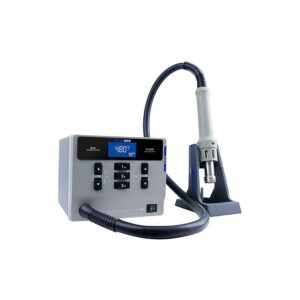
The ATTEN ST-862D is one of the strongest alternatives to the Quick 861DW.
It offers professional-level performance while generally being positioned as a more budget-conscious option.
The ST-862D is suitable for technicians working on smartphone motherboards, consumer electronics, SMD components, and other PCB repair jobs. Recent comparisons describe it as a strong choice for technicians upgrading from entry-level equipment.
Why choose the ST-862D?
If you want a serious hot air station but don’t want to spend as much as you might on a premium setup, the ATTEN is worth considering.
Pros
- Good temperature control
- Strong airflow performance
- Suitable for daily repair work
- Professional build quality
- Good alternative to Quick
Cons
- Still relatively expensive for beginners
- Genuine products and accessories should be purchased from a reliable seller
Best for
Professional technicians who want strong performance and good value.
Our rating: 4.9/5
3. Sugon 8630 Pro – Best Value for Chip-Level Repair
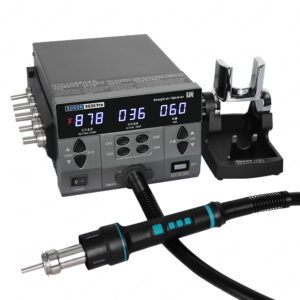
The Sugon 8630 Pro has become a popular option for technicians looking for high-performance hot air rework without moving immediately into premium-priced equipment.
The 8630 Pro is designed for PCB rework applications and provides adjustable temperature and airflow, making it suitable for mobile motherboard work.
Why choose it?
For a technician starting to move into serious chip-level repair, the Sugon 8630 Pro offers an attractive balance between capability and cost.
Pros
- Strong airflow
- High-power heating system
- Suitable for motherboard work
- Digital controls
- Good value
Cons
- Larger than some compact stations
- Build and after-sales support can depend heavily on the seller
Best for
Technicians who want a powerful station without spending heavily on premium brands.
Our rating: 4.8/5
4. Sugon 8650 Pro – Best for Advanced Rework
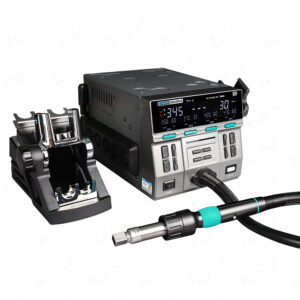
The Sugon 8650 Pro is another powerful option from Sugon and is aimed at more demanding PCB and rework applications.
It is particularly interesting for technicians who regularly work with larger components and more demanding motherboard repairs.
Pros
- Powerful heating
- Strong airflow
- Suitable for advanced PCB work
- Useful for larger ICs and components
- Good value compared with some premium stations
Cons
- May be unnecessary for basic repairs
- Requires good technique and experience
Best for
Advanced mobile motherboard and BGA-related work.
Our rating: 4.7/5
5. Goot XFC-110 – Best for Precision PCB Rework
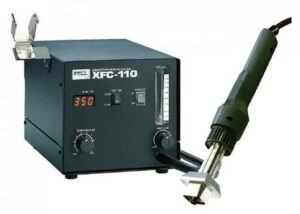
Goot is a respected name in soldering and rework equipment, and the XFC-110 is worth considering when precision is more important than simply having maximum airflow.
It is listed among the hot air stations suitable for smartphone PCB repair, SMD work, IC removal, and component replacement.
Pros
- Precision-oriented design
- Good temperature control
- Suitable for PCB rework
- Established manufacturer
Cons
- Availability can vary
- May cost more than some Chinese alternatives
Best for
Technicians who prioritize controlled and precise PCB rework.
Our rating: 4.6/5
6. Quick 957DW – Best Compact Professional Option
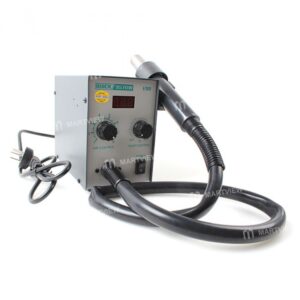
The Quick 957DW is another option from Quick for technicians who want professional-level equipment in a somewhat different form factor.
It is suitable for SMD rework and PCB servicing where controlled hot air is required.
Pros
- Quick brand reliability
- Good temperature control
- Professional-oriented design
- Suitable for PCB repair
Cons
- Less commonly chosen than the 861DW for mobile motherboard work
- Price may not make sense for beginners
Best for
Technicians looking for a compact professional Quick station.
Our rating: 4.5/5
7. YIHUA 959D – Good Choice for Beginners
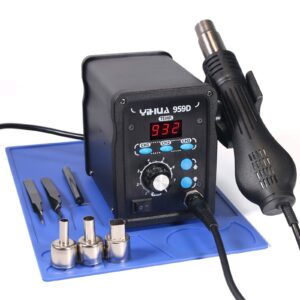
The YIHUA 959D is aimed more toward technicians who are entering the world of electronics and mobile repair.
It can be a reasonable starting point for SMD work and basic motherboard servicing.
Pros
- Beginner-friendly
- Affordable compared with professional stations
- Suitable for basic SMD work
- Easy to find in many markets
Cons
- Not our first choice for heavy professional motherboard work
- Long-term performance can differ between models and sellers
Best for
Beginners learning mobile motherboard repair.
Our rating: 4.2/5
8. YIHUA 8786D – Best Budget 2-in-1
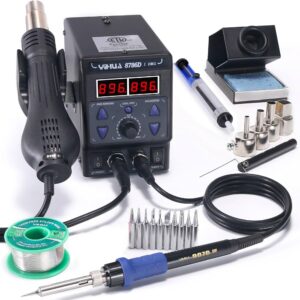
The YIHUA 8786D is interesting because it combines a hot air station with a soldering station.
For someone building a first repair bench, having two functions in one machine can be useful.
It is listed among commonly considered stations for mobile phone SMD and IC rework.
Pros
- Hot air + soldering iron
- Good for beginners
- Saves bench space
- Suitable for basic mobile repair
Cons
- Not the same class as dedicated professional stations
- Limited compared with buying separate professional equipment
Best for
Beginners building their first mobile repair workstation.
Our rating: 4.1/5
9. YIHUA 858D – Best Entry-Level Hot Air Station
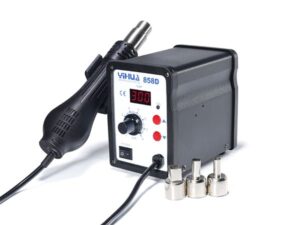
The YIHUA 858D is one of the commonly available entry-level hot air stations.
It can be useful for learning basic SMD desoldering and soldering techniques.
Pros
- Affordable
- Easy to learn
- Widely available
- Suitable for basic SMD work
Cons
- Not ideal for demanding professional motherboard work
- Airflow and temperature control are below higher-end stations
Best for
Beginners and hobby-level electronics repair.
Our rating: 3.8/5
10. JCD 8898 – Best Low-Budget Starter

The JCD 8898 is aimed at users who need an inexpensive way to get started with hot air work.
It can be useful for basic SMD jobs, but we would not recommend making it the main station for a professional chip-level repair business.
Pros
- Low purchase cost
- Simple to operate
- Suitable for basic repairs
Cons
- Lower-end construction
- Less suitable for demanding motherboard work
- Temperature and airflow control may not match professional stations
Best for
Beginners on a very limited budget.
Our rating: 3.5/5
Quick Comparison
| Rank | Model | Best For | Level |
|---|---|---|---|
| 1 | Quick 861DW | Professional motherboard repair | Professional |
| 2 | ATTEN ST-862D | Professional value | Professional |
| 3 | Sugon 8630 Pro | Chip-level repair | Intermediate/Professional |
| 4 | Sugon 8650 Pro | Advanced rework | Professional |
| 5 | Goot XFC-110 | Precision PCB work | Professional |
| 6 | Quick 957DW | Compact professional setup | Professional |
| 7 | YIHUA 959D | Beginner mobile repair | Beginner |
| 8 | YIHUA 8786D | Budget 2-in-1 setup | Beginner |
| 9 | YIHUA 858D | Entry-level SMD work | Beginner |
| 10 | JCD 8898 | Very low-budget repair | Beginner |
Which Hot Air Station Should You Buy?
The best choice depends on your experience and budget.
If you are a complete beginner
A YIHUA 959D or YIHUA 8786D can be a reasonable starting point.
You can learn:
- SMD component removal
- Connector replacement
- Basic IC removal
- Soldering techniques
- Airflow control
- Temperature control
However, if you already know that you want to progress into professional motherboard repair, it can make sense to invest in a better station from the beginning.
If you have a limited budget
The Sugon 8630 Pro is one of the most interesting choices.
It provides considerably more capability than many basic entry-level stations and is suitable for more serious PCB work.
If you run a professional mobile repair shop
The ATTEN ST-862D and Quick 861DW are the two models we would look at first.
The ATTEN is attractive for value, while the Quick has a particularly strong reputation among repair technicians.
If you want the best overall option
Quick 861DW is our overall pick.
It is not necessarily the cheapest option, but for a technician performing motherboard repairs every day, investing in a reliable hot air station can be worthwhile.
What Temperature Should You Use for Mobile Repair?
There is no single temperature that works for every mobile motherboard.
The correct setting depends on:
- Solder alloy
- PCB construction
- Component size
- Nozzle size
- Airflow
- Preheating
- Board condition
- Type of component being removed
A common mistake among beginners is to simply increase the temperature when a component does not move.
Instead, learn to control temperature and airflow together.
A large IC may require a different approach from a tiny SMD capacitor or a charging connector.
Why Airflow Is More Important Than Maximum Temperature
Many beginners choose a hot air station by looking at the highest temperature number on the specification sheet.
That is not the best way to compare stations.
For motherboard repair, you need controlled and stable heat rather than simply maximum heat.
Excessive airflow can blow away nearby components. Excessive temperature can damage the PCB, pads, connectors, or surrounding components.
Experienced repair users frequently emphasize airflow and heater design rather than wattage alone when comparing hot air stations.
Choosing the Correct Nozzle
Nozzle selection is also important.
Using a nozzle that is too large can spread heat over a larger area than necessary.
Using a nozzle that is too small can concentrate excessive heat on one point.
For mobile motherboard repair, it is useful to have several nozzle sizes available so that you can select the appropriate size for the component.
Tip
Use the smallest practical nozzle that provides adequate heating for the component and your technique.
Important Safety Tips
Hot air rework stations can reach very high temperatures.
Always:
- Work in a well-ventilated area
- Use appropriate eye protection
- Keep flammable materials away
- Never touch the nozzle while hot
- Return the handle to its stand after use
- Allow the station to cool properly
- Keep the workbench organized
- Use appropriate ESD protection when working on sensitive electronics
The Sugon 8630 Pro manual, for example, specifically recommends ventilation, protective equipment, keeping flammable materials away, and placing the hot air gun in its stand when not in use.
Final Verdict
A hot air rework station is an essential investment for anyone serious about mobile motherboard repair.
After considering performance, usability, repair applications, reputation, and value, our ranking is:
🥇 Quick 861DW – Best Overall
🥈 ATTEN ST-862D – Best Professional Value
🥉 Sugon 8630 Pro – Best Value for Chip-Level Repair
4. Sugon 8650 Pro – Best for Advanced Rework
5. Goot XFC-110 – Best for Precision PCB Rework
6. Quick 957DW – Best Compact Professional Option
7. YIHUA 959D – Best for Beginners
8. YIHUA 8786D – Best Budget 2-in-1
9. YIHUA 858D – Best Entry-Level Station
10. JCD 8898 – Best Low-Budget Starter
If you are building a professional mobile repair workstation, our first choice would be the Quick 861DW. If you want to reduce the initial investment while still getting a serious machine, the ATTEN ST-862D is an excellent alternative. For technicians looking for strong value, the Sugon 8630 Pro deserves serious consideration.
Most importantly, remember that the machine is only one part of successful chip-level repair. Your microscope, preheater, soldering station, flux, solder, PCB holder, ESD protection, and—most importantly—your repair technique all contribute to the final result.
Choose the station that matches your actual repair workload rather than simply choosing the station with the highest wattage or temperature rating.

